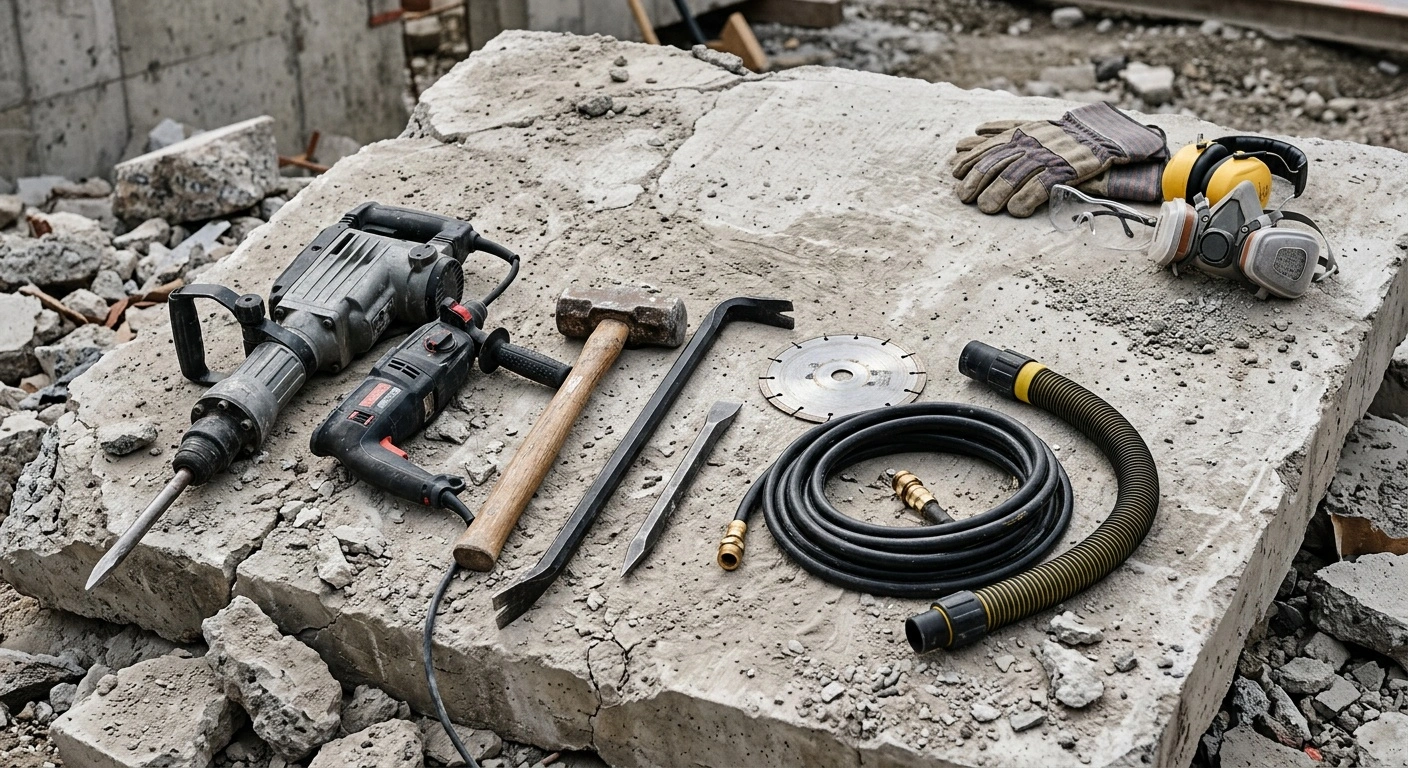
Concrete demolition tools range from hand-held chisels to excavator-mounted breakers, and the right choice depends on the slab’s thickness, access, and reinforcement. Matching the tool to the job reduces labor, limits damage, and helps crews work safely.
Start by checking the concrete, surrounding structure, and buried services. Then plan how you will break, control, lift, and remove each section.
How to Choose Concrete Demolition Tools
Concrete thickness provides a useful starting point. A sledgehammer may handle a thin patio slab, while a thick foundation usually requires powered equipment.
Access matters too. Large machines work quickly in open areas, but hand-held breakers offer more control inside buildings and near finished surfaces.
Before choosing equipment, assess these job conditions:
- Concrete thickness and compressive strength
- Rebar, wire mesh, or post-tensioning
- Indoor or outdoor access
- Nearby walls, pipes, cables, and occupied spaces
- Dust, noise, and vibration limits
- Available power, air, or hydraulic supply
- Debris size and removal route
Never cut or break a post-tensioned slab without a qualified structural assessment. Tensioned cables can release substantial energy if a tool strikes them.
Hand Tools for Small Demolition Jobs
Hand tools suit thin slabs, small repairs, and detailed work around edges. They also help crews finish areas that larger breakers cannot reach.
Sledgehammers
A sledgehammer works well on unreinforced concrete about four inches thick or less. Strike near a free edge or unsupported area rather than the center of a fully supported slab.
Create a void beneath the concrete when conditions allow. The empty space gives the slab room to fracture under each blow.
Cold Chisels and Masonry Chisels
Cold chisels remove small sections and clean rough edges. Use them with a drilling hammer or short-handled sledge for controlled strikes.
Keep the cutting edge in good condition. A mushroomed striking head can shed metal fragments and should receive attention before use.
Pry Bars and Wrecking Bars
Pry bars separate fractured pieces and expose reinforcement. They also help lift slab edges enough to place blocking underneath.
Do not rely on a pry bar to hold a heavy section in place. Use stable cribbing or mechanical lifting equipment before reaching below concrete.
Power Tools for Concrete Removal
Powered tools increase production and reduce repeated heavy swings. Choose a model that delivers enough impact energy without becoming difficult to control.
Rotary Hammers
A rotary hammer drills anchor holes and chips small areas with a chisel bit. SDS-plus models suit lighter work, while SDS-max models handle larger bits and harder concrete.
Use hammer-only mode for chipping. For holes, switch to hammer-drill mode and fit the correct masonry bit.
Demolition Hammers
A demolition hammer delivers repeated impacts without rotating the bit. It works well for tile beds, wall openings, slab edges, and medium-duty removal.
Lighter models provide better control on walls and overhead surfaces. Heavier units break floors faster, but they increase operator fatigue.
Electric and Pneumatic Breakers
Heavy breakers handle thick slabs, footings, and reinforced concrete. Electric models simplify setup where suitable power is available.
Pneumatic breakers require a compressor, hoses, and compatible fittings. They remain useful on demanding sites where crews need long operating periods.
Concrete Saws
Concrete saws create clean boundaries before breaking begins. A cut line protects adjoining surfaces and helps control the size of each removed section.
Walk-behind saws handle floor slabs, while handheld cut-off saws reach walls and tight spaces. Match the diamond blade to the concrete and cutting method.
Never cut deeper than necessary without checking for utilities and reinforcement. Use water or approved dust extraction when the equipment allows it.
Machine-Mounted Demolition Equipment
Excavators and skid steers move more concrete than hand-held equipment. They also keep operators farther from falling pieces and unstable edges.
Hydraulic Breakers
A hydraulic breaker attaches to an excavator, compact excavator, or skid steer. It delivers high impact force for slabs, foundations, bridge decks, and thick walls.
Select the attachment according to the carrier’s hydraulic flow and operating weight. An incorrect match can reduce performance or damage the machine.
Concrete Crushers and Pulverizers
Crushers use powerful jaws to break concrete into manageable pieces. Pulverizers also separate concrete from reinforcing steel during processing.
These attachments can reduce hauling volume and prepare clean material for recycling. Their jaws still require enough access to grip the structure safely.
Grapples and Buckets
Grapples sort broken concrete, scrap steel, and mixed debris. Heavy-duty buckets load material and remove loose sections after primary demolition.
Avoid using a standard bucket as a breaker. Impact work can damage pins, bushings, and the bucket structure.
Tools for Cutting Rebar and Wire Mesh
Reinforced slabs often remain connected after the concrete fractures. Expose the steel before cutting so the tool does not bind against hidden material.
Common cutting options include:
- Reciprocating saws with carbide or bi-metal blades
- Portable band saws for exposed bars
- Abrasive cut-off saws for fast field cuts
- Hydraulic rebar cutters for frequent or heavy work
- Bolt cutters for light wire mesh
Support each concrete section before cutting its reinforcement. The steel may hold a heavy piece in place, and cutting it can trigger sudden movement.
Dust, Noise, and Vibration Control
Concrete work can release respirable crystalline silica. Use wet cutting, on-tool extraction, or another control method that meets local workplace requirements.
A standard shop vacuum may not provide suitable filtration. Use equipment with the airflow, shroud, and HEPA filtration specified for the task.
Breakers and saws also create hazardous noise. Wear suitable hearing protection and restrict access to the work zone.
Repeated vibration can affect hands and arms. Rotate tasks, maintain tools, keep bits sharp, and follow the manufacturer’s exposure guidance.
Personal Protective Equipment
Personal protective equipment supports the work plan but does not replace proper controls. Inspect every item before starting the job.
- Safety glasses with side protection
- A face shield for flying chips
- Hearing protection
- Cut-resistant work gloves
- Steel-toe or composite-toe boots
- A hard hat where overhead hazards exist
- High-visibility clothing around mobile equipment
- A properly selected respirator when the exposure plan requires one
Respirators require correct selection, fit testing, and maintenance. Follow applicable workplace rules rather than treating a dust mask as a universal solution.
A Practical Demolition Sequence
Good sequencing improves production and keeps debris under control. Choosing concrete demolition tools is only one part of the plan.
- Locate utilities and confirm structural conditions.
- Mark the removal boundary.
- Saw-cut edges where a clean break matters.
- Start at an exposed edge or opening.
- Break the concrete into liftable sections.
- Expose and cut reinforcement under controlled conditions.
- Remove debris before it blocks access.
- Inspect the remaining surface for damage.
Do not create piles that exceed the floor’s load capacity. On upper levels, coordinate debris placement and removal with a qualified project professional.
Renting or Buying Demolition Equipment
Renting often makes sense for occasional projects or specialized attachments. It also gives contractors access to larger machines without storage and maintenance costs.
Buying may cost less over time when crews use the same tool regularly. Include bits, blades, repairs, inspections, and downtime in the calculation.
Before renting, confirm the power source, tool weight, accessories, and transport requirements. Ask the supplier to explain startup, shutdown, and daily inspection procedures.
Plan the Break Before Starting Work
The most effective concrete demolition tools match the material, access, and desired removal size. A saw and breaker often work better together than either tool alone.
Inspect the site first, control silica and noise, and support heavy sections before cutting reinforcement. Careful planning protects workers, nearby structures, and the equipment itself.